Building Environment and Energy Application Engineering
★Disciplinary background
The discipline of Building Environment and Energy Application Engineering primarily focuses on meeting the requirements for artificial environments in human living, working, production, scientific research, national defense, and other areas, thereby supporting the strategic goal of Healthy China Initiative.
Taking human-enclosed spaces such as buildings as the primary focus, on the basis of making full use of natural energy, artificial environment and energy utilization engineering technology are adopted to create healthy environment suitable for human living and working, process environments that meet the requirements of product production and scientific experiments, as well as artificial environments that meet the requirements of special application fields. These include underground (or underwater) engineering environment, extreme climate engineering environment, national defense engineering environment, and interior environment of transportation vehicles, etc.
Nowadays, intelligent construction, smart operation and maintenance, and green development have become the trends in the modern construction industry. Especially with the advancement of computer technology, the application of modern technologies represented by the internet of things, cloud computing, and big data has profoundly transformed the development landscape of the modern construction industry and put forward more and higher requirements for the internal equipment of buildings. To adapt to the development of the modern construction industry, high-caliber professionals in the Building Environment and Energy Application Engineering field should possess the following competencies: the ability to actively acquire knowledge, practical operational skills, communication and coordination skills, innovation and entrepreneurial capabilities, as well as the ability to solve complex engineering problems, etc.
★Development journey of discipline

★Foundation for program development
★Cultivation objective
The objective is to cultivate high-level applied talents in the field of Building Environment and Energy Application Engineering who can adapt to the needs of China's socialist modernization drive, possess a strong sense of social responsibility and professional dedication, and are well-rounded in morality, intelligence, physical fitness, aesthetics, and labor. These talents should have a solid foundation, broad knowledge, strong abilities, high quality, and innovative consciousness. The cultivated talents are able to engage in air conditioning, heating, ventilation, etc. in the fields of civil construction; industrial ventilation, dust removal, smoke purification of industrial enterprises such as metallurgy industry; design, installation, commissioning, operation management and other work of public facilities systems such as building energy supply systems and gas supply systems, and have the ability to work in technical or management positions such as planning and design, research and development and manufacturing, construction and installation, operation management and system guarantee in the fields of heating, ventilation, air conditioning, purification, cold and heat sources, heating supply and gas in units such as design research institutes, engineering construction companies, equipment manufacturing enterprises, operation companies and energy management companies.
Length of Schooling: Four years Degree: Bachelor of Engineering
★Teaching staff requirements for the discipline
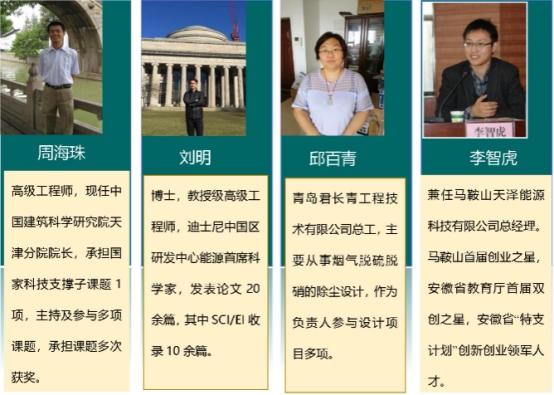
There are 20 professional teachers, including 3 professors and 5 associate professors, with senior professional titles accounting for 40% of the total. Among them, 16 hold doctoral degrees, representing 80% of the faculty. Graduated from prestigious universities specializing in HVAC such as Tongji University, Southeast University, University of Science and Technology of China, Tianjin University, Chongqing University, Hong Kong Polytechnic University, and Dalian University of Technology.
Since 2018: Professional teachers have been approved for 13 longitudinal scientific research projects such as national level and major special projects, 8 major industry-university-research cooperation projects, and over 60 general industry-university-research cooperation projects, 3 provincial and ministerial level scientific and technological progress awards, 2 industry association awards, 6 provincial teaching achievement awards, 7 teaching research projects and industry-university-research association personnel education projects of the Ministry of Education, 26 provincial-level educational reform projects, over 10 provincial-level excellent courses, and 4 provincial and university-level teaching masters and new teaching stars. Major students have won 38 awards in various subject and science and technology competitions (including 18 national-level awards and 20 provincial-level awards), including 1 first prize of the 13th China Creativity Society Creation Achievement Award. More than 200 academic papers have been published (including 107 SCI-indexed papers and 22 EI-indexed papers), and 18 invention patents and 10 utility model patents have been authorized.
Meanwhile, the Faculty Party Branch of the Department of Building Environment and Energy Application Engineering was awarded the university-level "Advanced Party Branch" for two consecutive years in 2018 and 2019. In 2019, it was selected as one of the second batch of "National Model Party Branches for Party Building Work" by the Ministry of Education and one of the first batch of "Model Party Branches for Party Building Work in Colleges and Universities in Anhui Province". In May 2022, it passed the national acceptance inspection. In 2021, the university-level "Dual Leader" Teacher Party Branch Secretary Studio was initiated.
★Dynamics of talent cultivation
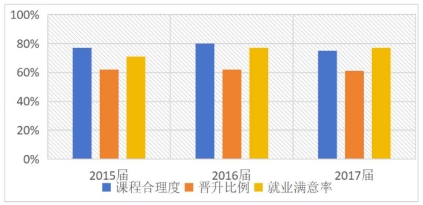
Over the years, apart from those pursuing self-employment, the employment rate of graduates from this major (including further studies) has consistently remained above 98.5%. The average annual recommendation rate for graduate studies stands at approximately 4%, while over 35% of students successfully pass the national postgraduate entrance examination. Among them, nearly half are admitted to universities recognized as part of China's "985" or "211" initiatives.
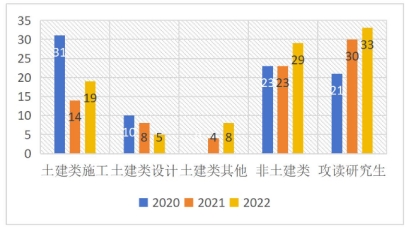
Employment outcomes by category
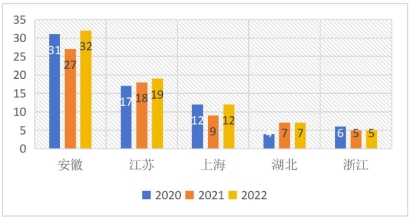
Geographic distribution of employment
Survey data of graduates 5 years post-graduation Distinguished alumni